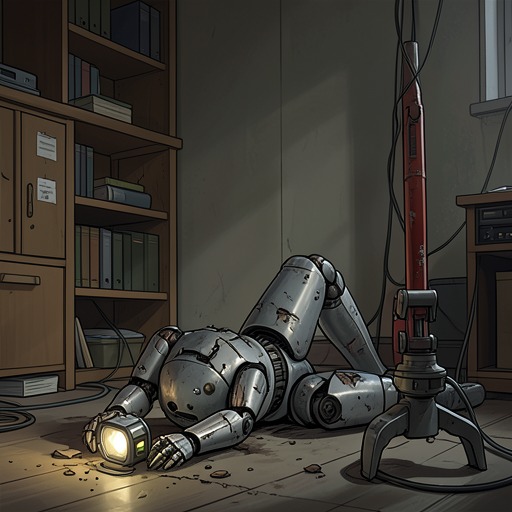
Williamsburg power plant
The Caves of SteelThe Williamsburg power plant embodies the dependence and danger built into City life. It generates energy within a tightly connected urban system, but its radioactive materials and controlled zones make that infrastructure tangible—and, when an Alphasprayer from the plant becomes part of the investigation, the facility also provides Elijah Baley with a decisive clue.
Place in the City System
The power plant belongs to the network that makes New York City possible. City culture concentrates people and production in vast, largely self-sufficient urban units: New York City covers more than two thousand square miles and holds well over twenty million people, while Earth has about eight hundred Cities with an average population of ten million. The City’s design gathers administrative offices, residential Sections, expressways, factories, hydroponic plants, yeast vats, and power plants into one organized whole, threaded through with water and sewage systems, power lines, schools, shops, and communications.
That apparent self-sufficiency depends on continuous exchange. New York must bring in water and remove waste; nuclear plants need uranium that is increasingly difficult to obtain, while yeast vats depend on wood pulp and hydroponic plants on minerals. Air must circulate without interruption. The Williamsburg plant therefore belongs to a system whose strength is coordination but whose vulnerability is interdependence: a break in the flow of supplies and services could threaten the City within an hour.
The plant’s place in the broader argument about Earth is equally important. City culture represents humanity’s mastery of its environment, yet the machinery sustaining that achievement rests on increasingly delicate balances. In the discussion of Earth’s future, introducing robots is described as a way for Spacetown to unsettle the City economy; the resulting displaced and declassified people are meant to form a nucleus for colonization. The plant is thus part of the material order that is both a triumph of urban organization and a pressure point in a political struggle over labor and humanity’s future.
Inside the Plant
Elijah Baley has visited the Williamsburg power plant before, but familiarity does not dispel his awe. On entering during the investigation, he recognizes the place and says that it breaks their tracks completely. Around him, generators hum in a central well; ozone sharpens the air, and red lines mark limits that no one may cross without protective clothing. The power plant is not merely an abstract supplier in a diagram of the City: its sound, restricted zones, and industrial scale make the costs of keeping that diagram alive physically present.
A pound of fissionable material is consumed there each day. Radioactive fission products, known as hot ash, are periodically driven by air pressure through lead pipes to distant caverns ten miles out in the ocean and half a mile below its floor. Baley wonders what will happen when those caverns are full. The plant’s operation therefore reaches beyond its walls: energy production requires the handling and removal of dangerous waste, with the future capacity of its disposal sites left unresolved.
Baley tells R. Daneel Olivaw to stay away from the red lines, then sheepishly recognizes that the warning may not apply to him in the same way. R. Daneel asks whether Baley means radioactivity. In this brief exchange, the plant’s hazards also expose a difference between human vulnerability and a robot’s relation to the environment: a caution grounded in Baley’s bodily safety may have a different force for his partner.
The Plant and the Investigation
The plant becomes relevant to the murder investigation through a weapon. When Baley asks Commissioner Julius Enderby whether the Alphasprayer has been traced, Enderby says it came from one of the power plants. Baley follows up by asking which one. The answer—Williamsburg—causes him to freeze. As he reconsiders the events of the preceding days, their separate pieces begin to fit together, although he initially conceals the importance of the answer by responding that it is nothing.
Later, at 22:45, Enderby asks when Baley was last at the Williamsburg plant. Baley replies that he was there the previous day after leaving the office, at about eighteen o’clock or shortly afterward. Enderby challenges him for not having said so earlier. These details place Baley’s visit within the timeline of the inquiry and turn an ordinary stop at a familiar facility into a fact requiring explanation.
The plant’s importance is consequently double. It is a vital component of the City’s energy system, with radioactive material, distant waste caverns, and stringent safety boundaries; it is also the source identified for the Alphasprayer and the site of Baley’s recent visit. Its infrastructure connects the City’s everyday survival to the investigation’s chain of evidence, making the power plant both a foundation of urban order and a point where that order’s hidden dependencies become visible.